CNC router bit and tool selection for furniture: diameter, spindle speed, feed and V-bits
CNC8 min readBy moducut
Summarize this article with an AI tool:
Short answer
Why does tool selection affect sizes?
On a CNC, the cutter travels around the part offset by its own radius. The software makes this calculation based on the tool diameter. If a cutter listed as 8 mm in the profile has actually worn to 7.8 mm, every part comes out 0.2 mm oversize; holes and grooves shift by the same amount.
So tool selection is not only about cut quality but about accuracy. Good furniture CNC software reads the tool diameter from the machine profile and calculates the toolpath accordingly; making sure the value in the profile matches the real tool is the workshop's responsibility.
Which tools are used in furniture?
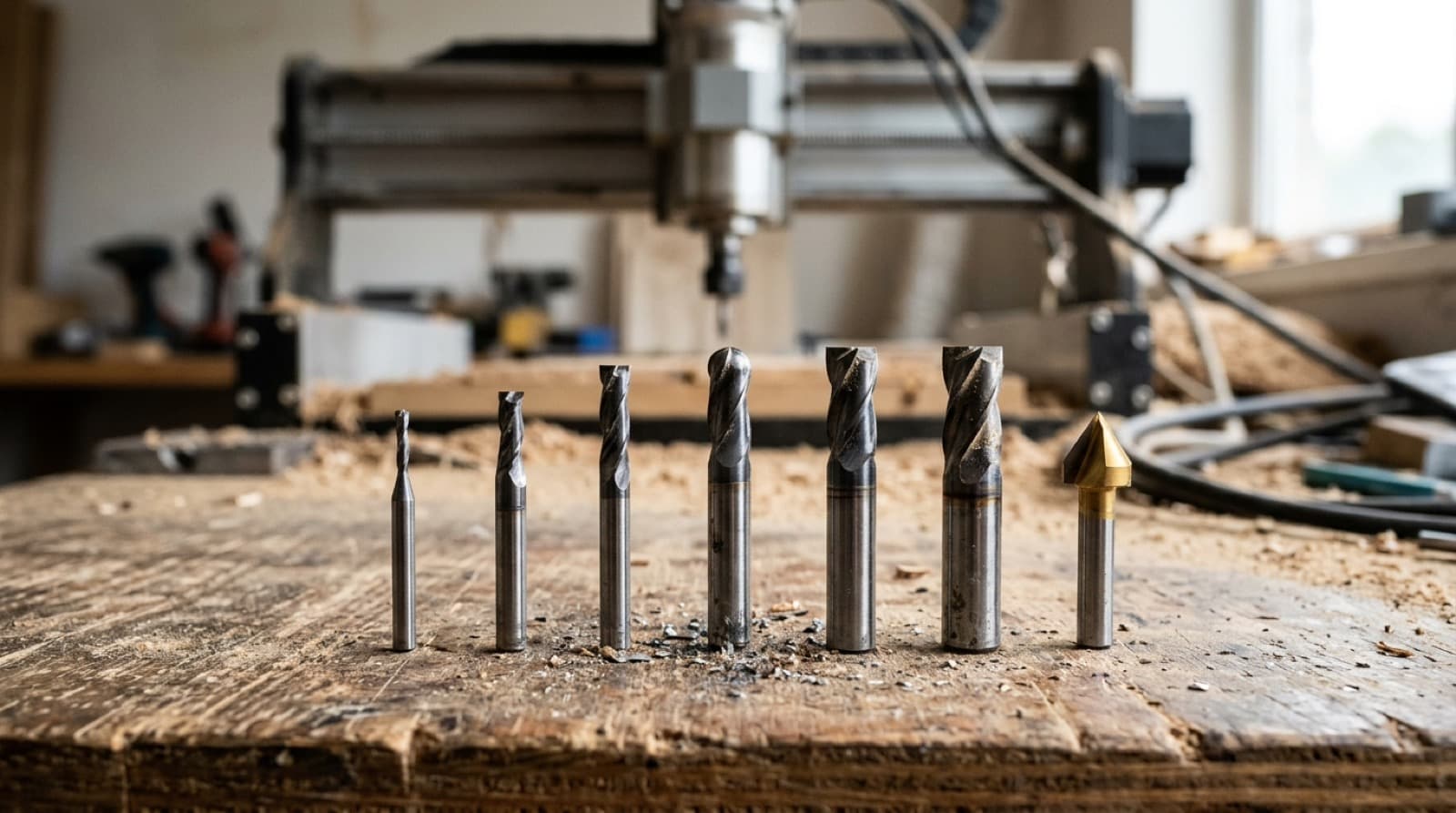
| Tool | Use | Typical diameter | Note |
|---|---|---|---|
| Compression spiral cutter | Outer cut of laminated board | 6–10 mm | No chipping on top or bottom face |
| Down-cut spiral cutter | Thin sheets, pockets | 4–8 mm | Pushes chips down, clean top face |
| Up-cut spiral cutter | Deep pockets, MDF | 4–8 mm | Clears chips well, risk of chipping on top face |
| Straight (groove) cutter | Back panel groove | To suit groove width | Groove in one or two passes |
| Drill bit | Dowel, shelf pin, cup | Ø5, Ø8, Ø35 mm | Single plunge, fast |
| V-bit | 45° mitre, V-groove, lettering | 90° angle | Depth gives width according to angle |
How do you choose cutter diameter?
Large diameter: speed and strength
A 10 mm cutter is stronger, can feed faster and has a low risk of breaking. But the cutting allowance between parts also grows; fewer parts fit on the sheet and inner corners have a larger radius.
Small diameter: less waste, tighter corners
A 6 mm cutter wastes less material between parts and leaves sharper inner corners. In return it has to be fed more slowly and can break if strained for long.
Most workshops start with a cutter of around 8 mm for carcass cutting and switch to a smaller diameter for doors and shaped parts that need tight inner corners.
How do you set spindle speed and feed?
Spindle speed (revolutions per minute) and feed (distance travelled per minute) are considered together. The rule is simple: each cutting edge should take a chip of a certain thickness on every turn.
- If the chips are like dust: Feed is too low or spindle speed too high. The tool rubs, heats up and dulls quickly; burn marks can appear on the cut surface.
- If the chips are coarse and the cut is loud: Feed is too high. The tool is strained, with chatter marks on the edge and a risk of breaking.
- If the chips are small particles: The setting is in the right range.
Values given by the tool manufacturer are a starting point. The sheet type (melamine board, MDF, plywood), its thickness and the rigidity of the machine change the right value. Make changes in small steps, not all at once, and look at the cut surface.
How many passes should you cut in?
18 mm melamine board can often be cut in a single pass on a rigid machine with a suitable cutter. If the machine is light or the tool has a small diameter, the cut is split into two passes. A single pass is fast; two passes put less strain on the tool and machine. A small overcut into the spoilboard is left below the sheet so a thin skin does not remain on the underside. For details of the sizing pass, see our sizing and inner cuts document.
How is a 45° mitre made with a V-bit?
In a mitre joint, the edges of two parts are cut at 45° and the edge does not show at the outer corner once they are joined. A three-axis router cannot cut an edge at an angle; but with a 90° V-bit it can cut a V-groove into the face of the sheet.
There are two ways:
- Mitre on the part edge: An angled chamfer is cut along the part edge with a V-bit. On thick board the V-bit goes down in several steps (rough first, then fine).
- V-folding: Sides and tops are cut from a single sheet; at the corners V-grooves that almost cut through to the underside are machined, and the part is folded and glued. The grain wraps around the corner without a break.
With a V-bit, depth directly determines width: with a 90° bit, 1 mm of depth means 2 mm of width at the surface. That is why the accuracy of the Z zero matters more than ever in V operations.
How does tool selection change with the material?
The same cutter does not give the same result on every sheet. For the materials cut most often in workshops, the general tendencies are:
| Material | Recommended tool | Watch for |
|---|---|---|
| Melamine board | Compression spiral | Prevents chipping on top and bottom laminate |
| Raw MDF | Up-cut spiral or straight cutter | Produces lots of chips; good extraction needed |
| MDF for painting | Down-cut spiral or compression | Top face must stay clean; marks show through paint |
| Thin back panels (3–8 mm) | Small-diameter down-cut spiral | Light parts; vacuum and cutting order are critical |
| Plywood | Compression spiral | Fuzzing can occur because of ply directions |
MDF is more uniform than melamine board and chips less, but produces finer dust. Melamine board has a hard laminate and a soft core; the tool has to cut two different layers cleanly at the same time. That is why compression cutters are common on melamine board.
How do tool changes affect the program?
On a multi-tool machine (with an automatic tool changer), the software groups operations by tool: first all the holes with the drill bit, then the grooves with the groove cutter, and finally the cuts with the outer-cut cutter. This keeps tool changes to a minimum.
On a machine without a tool changer there are two ways: all work is done with a single cutter, or the program stops at the tool change and the operator changes the tool by hand. With a manual change, the Z zero has to be taken again after every change; otherwise depths shift. This shows up immediately in V-bit and groove operations.
Tool change time is also added to the total. When estimating cutting time, account not only for the toolpath but also for tool changes and idle travel. We explained how cutting order reduces idle travel in our CNC cutting order article.
How do you track tool wear?
- Measure the cutter diameter with a caliper at regular intervals and compare it with the value in the profile.
- If burning, fuzzing or chipping of the laminate starts on the cut surface, the tool has dulled.
- If parts in the same program come out a little bigger every week, the diameter is shrinking.
- When a tool is changed, update the diameter in the profile too.
The main factors that speed up wear are a wrong spindle speed–feed balance, poor chip extraction and hard laminated boards. If chips build up around the tool, the tool recuts the same chips again and again, heats up and dulls quickly. So the extraction system also directly affects tool life. The cheapest way to protect an expensive cutter is the right settings and a clean table.
How does moducut use tools?
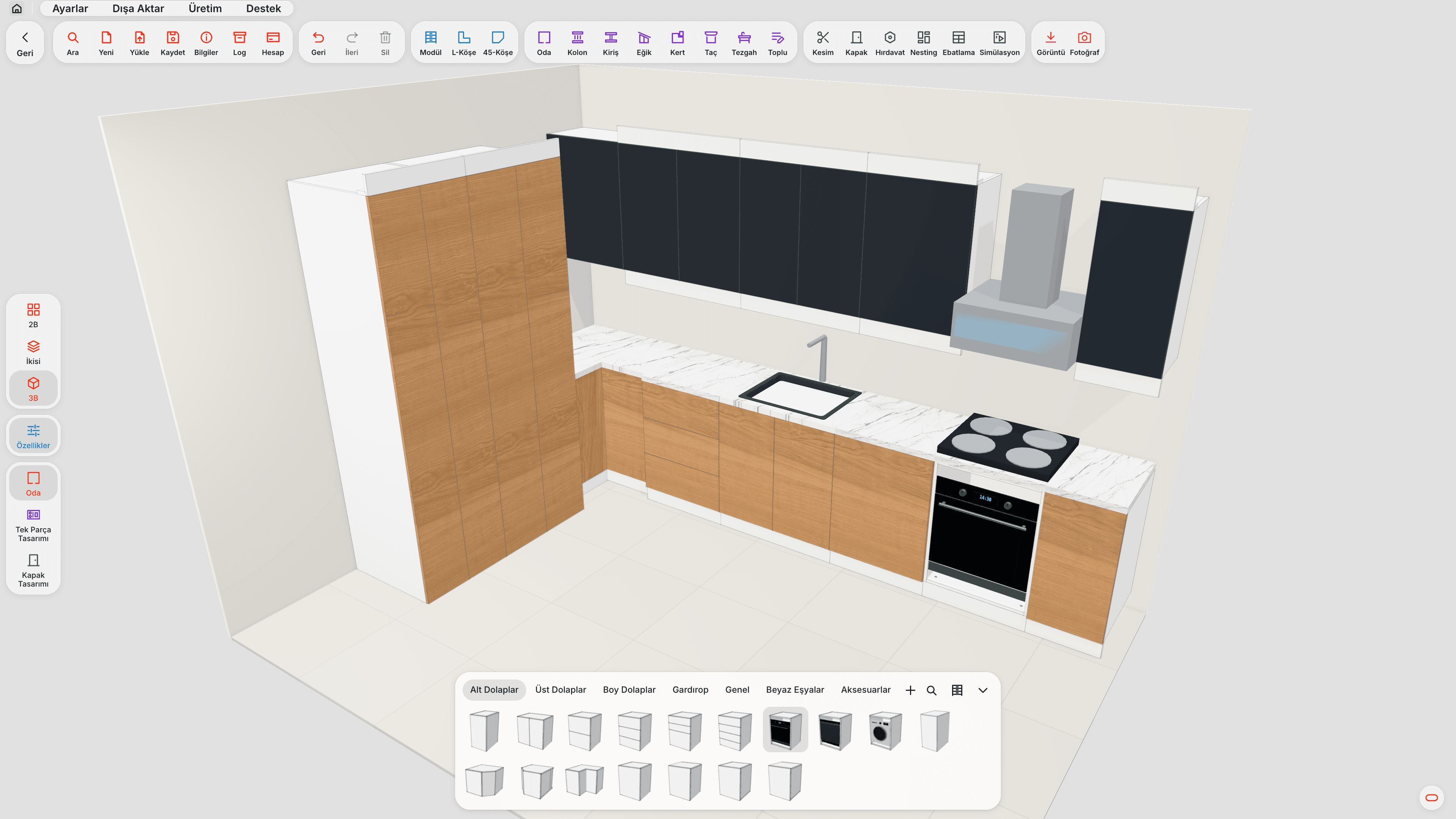
In moducut, tools are defined in the machine profile: number, diameter and operations. When G-code is written, outer cuts, holes, grooves and pockets are assigned to the right tool and the toolpath is calculated according to the tool diameter. A V-bit is used for 45° mitres on straight part edges and for V-folding; in stepped V-carving each mitre is passed rough first and then fine immediately after.
If wanted, PVC-banded edges are marked on the sheet with a separate pen tool; the spindle does not turn. You can watch all operations in the cutting simulation before sending them to the machine.
For details, see the G-code and CNC page, and for the overall flow our furniture CNC software article.
Frequently asked questions
Which is the best cutter for melamine board? On laminated melamine board, a carbide compression spiral cutter is the common choice because it cuts both faces cleanly.
Can I do all the work with a single cutter? It is possible to do outer cuts, grooves and pockets with a single cutter; holes are made as circles with a small-diameter cutter. It takes longer, but no tool change is needed.
Can a 45° mitre be made without a V-bit? On a three-axis router, the practical way to cut an edge at an angle is a V-bit. The alternative is to cut the mitre on a saw.
What happens if the tool diameter is entered wrongly? All parts and hole positions shift by that difference. Even if furniture CNC software calculates correctly, the diameter in the profile must match the real tool.
Who sets spindle speed and feed? The starting values come from the tool manufacturer; they are entered once in the machine profile and improved in small steps by looking at the cut surface.
What changes with thick board (25–36 mm)? Because the cutting depth increases, the tool has to be longer and the cut is usually split into two or more passes. A long cutter flexes more easily; feed is reduced a little so the edge comes out square. With a V-bit mitre, thick board needs more steps.