MDF and particleboard sizes: standard sheet sizes and thicknesses
Updated: Materials5 min readBy moducut team
Summarize this article with an AI tool:
Short answer
Particleboard, melamine chipboard, MDF and melamine MDF: what's the difference?
- Particleboard (chipboard). Made by pressing wood chips with glue. In furniture it is mostly used with a surface finish.
- Melamine chipboard. Particleboard with a melamine-faced surface. It is the most common material for furniture carcasses, with a wide range of colors and decors.
- MDF. Medium-density fiberboard made from wood fibers. Because its core is uniform, it is better suited to edge profiles, routing and paint.
- Melamine MDF. Melamine-faced MDF. It is denser and heavier than melamine chipboard and is preferred for doors and parts with machined edges.
- HDF. Thin high-density fiberboard, often used for back panels and drawer bottoms.
Lacquered, acrylic and high-gloss door panels are separate product groups; their sizes and thicknesses vary by manufacturer.
Standard MDF and particleboard sheet sizes
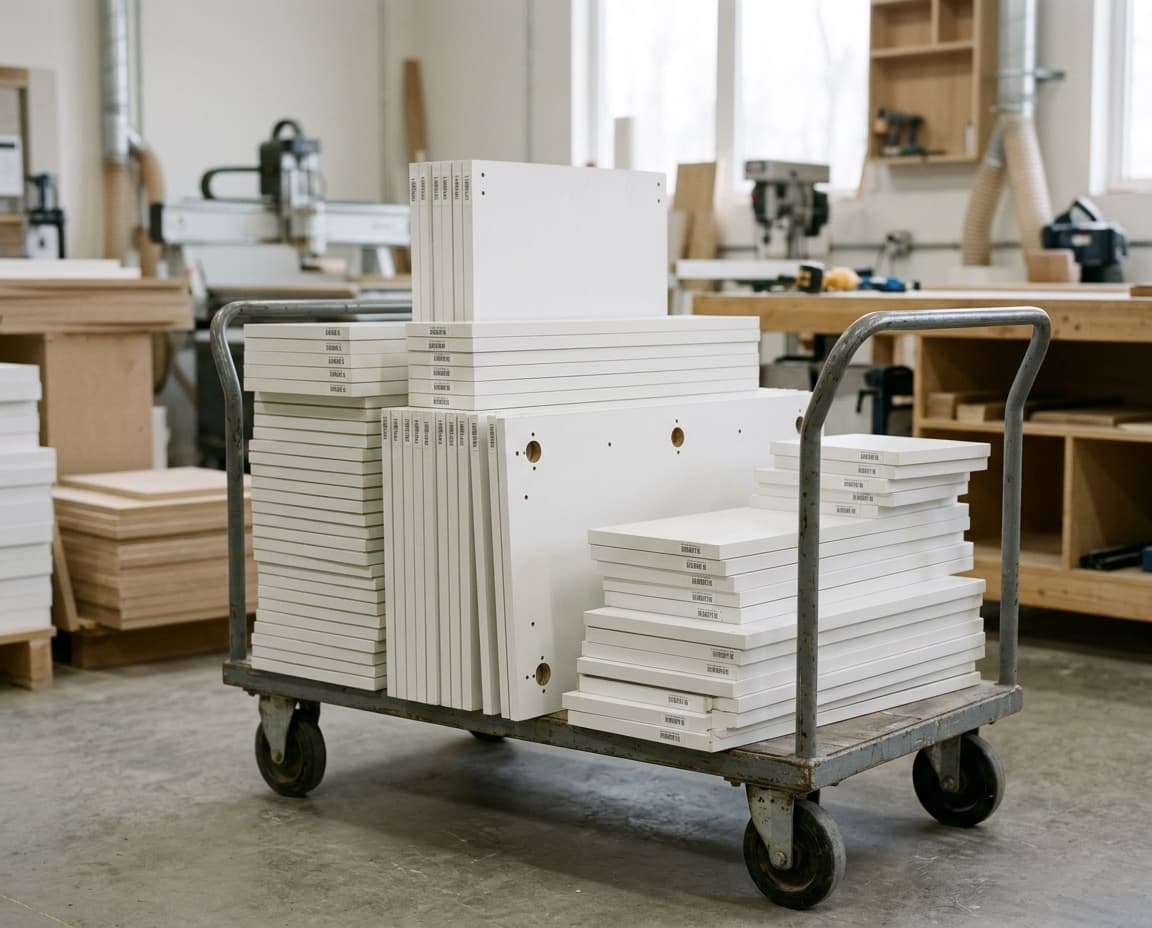
In Turkey, MDF and particleboard sheets are mostly available in these sizes:
- 2100 × 2800 mm
- most common melamine chipboard and melamine MDF size (5.88 m²)
- 1830 × 3660 mm
- long sheet, for long parts (6.70 m²)
- 1220 × 2440 mm
- plywood and some MDF and HDF products (2.98 m²)
Some imported products also come in metric sizes such as 1250 × 2500 mm. On patterned boards the grain usually runs along the long edge of the sheet. Ask your supplier which sizes are in stock; the same decor may not be made in every size and thickness.
| Sheet size | Area | Where it is useful |
|---|---|---|
| 2100 × 2800 mm | 5.88 m² | Carcasses, shelves and doors; most kitchen and wardrobe jobs |
| 1830 × 3660 mm | 6.70 m² | Long parts such as tall cabinet sides, long shelves and end panels |
| 1220 × 2440 mm | 2.98 m² | Plywood, HDF back panels and some MDF products |
Which standards are MDF and particleboard made to?
The technical properties of furniture boards are defined by European standards; in Turkey these are published with a TS EN number. EN 312 applies to particleboard, EN 622-5 to dry-process fiberboard (MDF), and EN 14322 to melamine-faced boards (melamine chipboard, melamine MDF). EN 14322 sets the surface requirements and dimensional tolerances of melamine-faced boards, not the size of the sheets sold. Size and thickness options come from the manufacturer's catalog.
Board thicknesses and where they are used
Thickness is chosen by the load the part will carry and the look you want. Common use is as follows:
- 3–4 mm (HDF). Nailed-on back panels and drawer bottoms.
- 8 mm. Grooved back panels; drawer bottoms in some shops.
- 16 mm. Drawer boxes and light carcasses.
- 18 mm. The most common thickness for carcasses, shelves, dividers and doors.
- 25 mm. Long-span shelves, load-bearing dividers and places where a thick look is wanted.
- 30 mm and up. Countertops, tabletops and custom designs.
These are common choices; your shop's construction method and the hardware you use also determine thickness. Hinges, connectors and drawer runners are made for specific thickness ranges; check that the hardware fits before changing the carcass thickness.
How much area do you get from one sheet?
The area of a sheet on paper is not the same as its usable area. Two allowances are deducted:
- Edge trim. Sheet edges may be crushed in transport or not quite square; a few millimeters are taken off each edge. With 10 mm off each edge, the usable size of a 2100 × 2800 mm sheet drops to 2080 × 2780 mm.
- Kerf. Every cut removes material equal to the thickness of the saw blade or CNC bit. On panel saws this is a few millimeters; on a CNC it is the bit diameter.
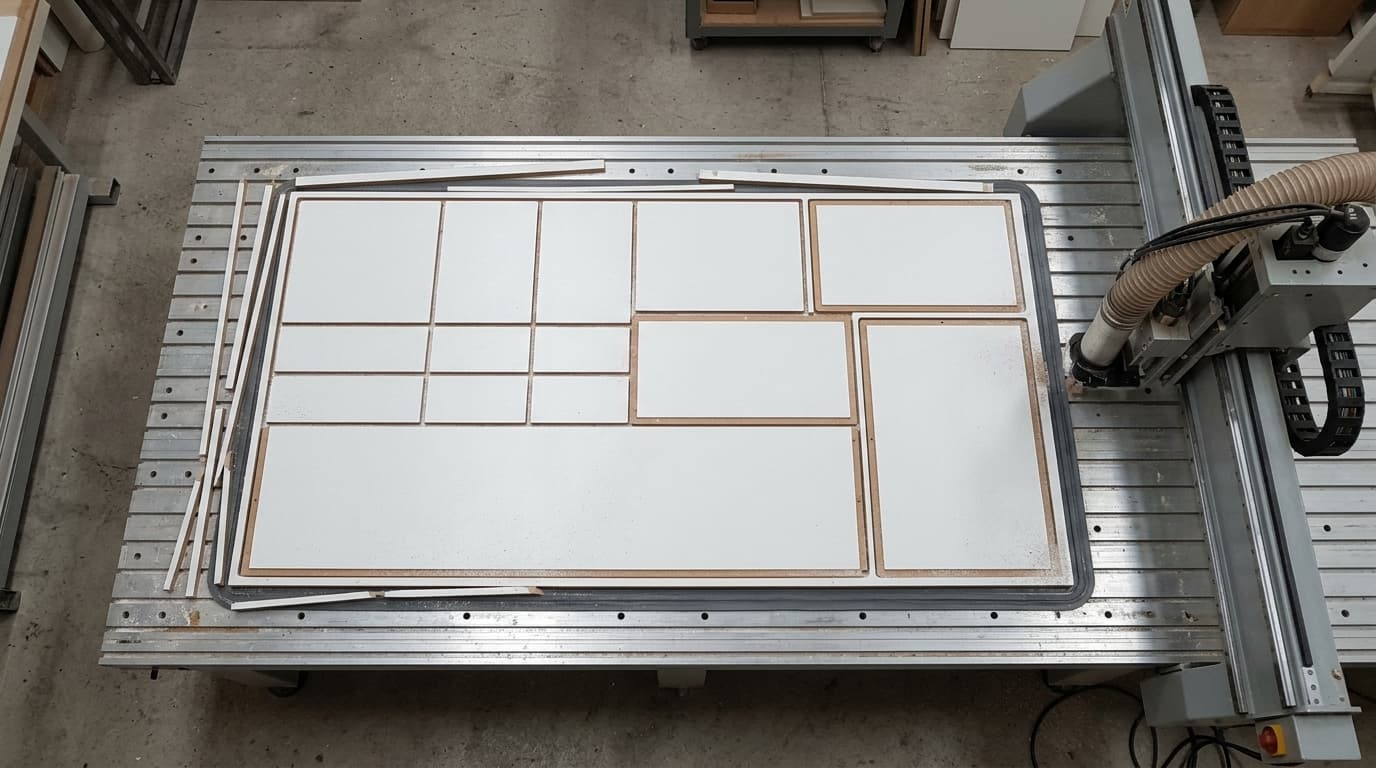
Then there is waste: parts never fill a sheet completely. Waste depends on the part sizes and the layout; for more, see the panel nesting software article.
Roughly calculating how many sheets you need
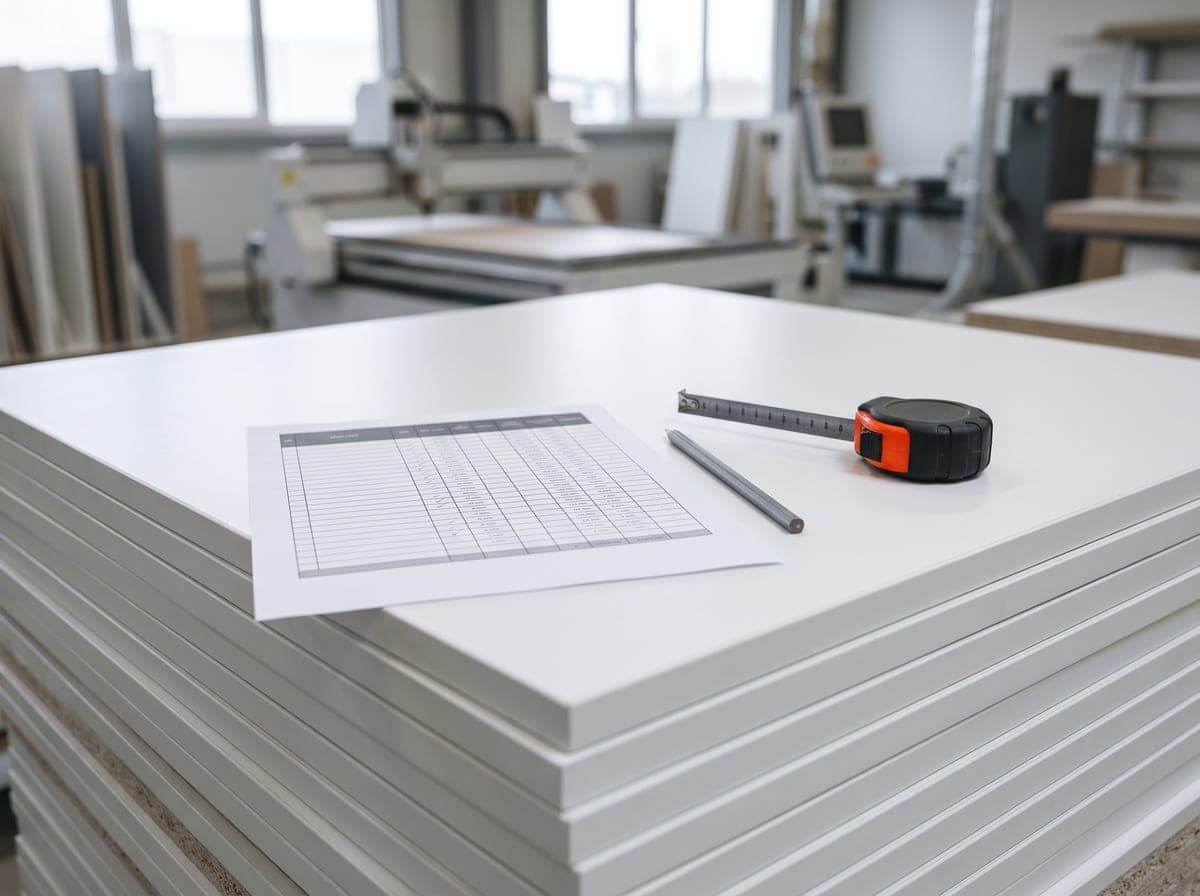
- Add up the areas of the parts on the cut list (length × width × quantity).
- Divide that total by the usable area of the sheet.
- Add an allowance for waste and round up.
- On patterned boards with many grain-locked parts, keep the allowance a little larger.
This gives a rough estimate before ordering; the exact sheet count comes from the layout. To enter part sizes and see an estimated sheet count and waste, you can use the free sheet calculator.
Grain direction and sheet choice
On woodgrain boards the pattern runs in one direction. On doors and visible sides the grain should run the same way, so these parts cannot be rotated on the sheet. On plain-colored boards, parts can be placed either way, which gives the layout more room.
When working with patterned boards, grain direction must be marked on both the cut list and the cutting plan; otherwise doors with horizontal and vertical grain can end up side by side in the same kitchen. For a short definition of the term, see the grain direction entry.
How to choose edge banding for the board
Edge banding is chosen a few millimeters wider than the board thickness; the overhang is trimmed and cleaned during banding. For an 18 mm board, 22 mm wide band is common. Thickness is chosen for the wear the edge will take: the most common thicknesses on the market are 0.4 mm, 0.8 mm, 1 mm and 2 mm. Thick band is preferred on doors and edges that take knocks, thin band on inner and less visible edges.
PVC and ABS are the most common banding materials; both are made in colors and patterns that match the board decor. Giving the board's decor code when ordering band makes color and pattern matching easier. For which edges get banded and the cutting size of banded parts, see the cut list software article.
How should boards be stored?
Boards should be stored flat on a level, solid surface and away from moisture. A board leaned against a wall for a long time can warp; on a warped board neither the cutting size nor the CNC cutting depth holds. Particleboard set directly on a wet floor or left in a damp room can swell at the edges. If possible, let newly delivered boards sit in the shop for a while before cutting so they adjust to the room temperature.
Defining boards in moducut
In moducut, a new project's board starts as 18 mm melamine chipboard at 2100 × 2800 mm. In Nesting Settings you enter the sheet size for each material separately; in the Panel Sizing window you can also choose from preset sizes such as 2800 × 2100, 3660 × 1830 and 2440 × 1220 mm. In the cutting plan, kerf and edge margin are deducted from the sheet, and grain direction is kept per part. If you add your leftover pieces as offcut sheets with their sizes, nesting fills them first. See the nesting page for details.
Frequently asked questions
What are the standard MDF sizes?
MDF and melamine MDF sheets are mostly sold at 2100 × 2800 mm and 1830 × 3660 mm, and some products at 1220 × 2440 mm. Thickness ranges from 3–4 mm HDF to 30 mm and more; furniture mostly uses 18 mm.
What size is a particleboard sheet in cm?
The most common melamine chipboard size is 210 × 280 cm (2100 × 2800 mm). Long sheets of 183 × 366 cm are also sold; which sizes are in stock depends on the brand and decor.
Which is better, MDF or melamine chipboard?
It depends on the job. Melamine chipboard is lighter and cheaper and is common for carcasses; MDF is denser and preferred for doors that need edge machining, profiles or paint.
What board thickness is used for furniture carcasses?
The most common thickness is 18 mm. 16 mm for drawer boxes, 3–8 mm for back panels, and 25 mm for long shelves and load-bearing dividers are also common.