Furniture cost calculation: per linear meter or part by part?
Updated: Costing5 min readBy moducut team

Summarize this article with an AI tool:
Short answer
What is a linear meter price?
A linear meter price is the price or cost per meter of furniture. In kitchens it is usually multiplied by the cabinet length measured along the wall: a 4-meter run of base cabinets costs four times the linear meter price.
Practice varies from shop to shop. Some price base and wall cabinets at separate linear meter rates, some together; tall cabinets, corners and countertops are often separate items. Whichever method you use, stating clearly in the quote what is included in the linear meter price prevents arguments later.
Where does a linear meter price mislead?
A linear meter price assumes the contents of all cabinets are roughly the same. But the cost of the same meter can vary a lot:
- Drawers and doors. A two-door cabinet and a four-drawer cabinet can be the same width, but the drawer boxes, runners and handles push the cost up noticeably.
- Door material. The difference between a melamine door and a lacquered or acrylic door depends on door area, not on meters.
- Appliance modules. A dishwasher or oven module has few carcass parts, but different sizes and labor.
- Corner and special modules. L-corners, blind corners, angled modules and column notches add labor.
- Waste. When only a few parts are cut from one material, the rest of the sheet shows up in the cost as waste.
If you set your linear meter price based on an average kitchen, your margin quietly melts away on drawer-heavy jobs or jobs with special doors.
| Linear meter | Item by item | |
|---|---|---|
| What it looks at | Length of the cabinet run along the wall | Sheet count, band meters, hardware, labor and overheads |
| Speed | Instant quote from measurements | Needs a cut list and cutting plan |
| Where it drifts | Drawers, glass doors, special and corner modules | If unit prices are out of date |
| When it fits | Preliminary quotes and similar jobs | Firm quotes and jobs with varying contents |
Example: two different cabinets in the same meter
Let's compare two base cabinets 800 mm (80 cm) wide. One has two doors and one shelf, the other four drawers. Priced by the linear meter, both cost the same; item by item, they do not:
| Item | Two doors, one shelf | Four drawers |
|---|---|---|
| Hinges | 4 | None |
| Drawer runners | None | 4 sets |
| Handles | 2 | 4 |
| Extra board parts beyond the carcass | None | About 20 (drawer boxes) |
- Hardware. The two-door cabinet has 4 hinges and 2 handles. The drawer cabinet needs 4 sets of drawer runners and 4 handles; runners are usually a more expensive item than hinges.
- Board. For a drawer with a wooden box, sides, back, inner front and bottom are cut for each drawer; four drawers add around twenty more parts on top of the carcass.
- Edge banding. Four drawer fronts and the top edges of the drawer boxes increase the band meters.
- Labor. More parts mean more cutting, banding, drilling and assembly time.
The same linear meter price can make a profit on the first cabinet and a loss on the second. On jobs with drawers, glass doors or special modules, listing these items separately next to the linear meter price is one way to reflect the difference in the quote.
The items that make up furniture cost
- Board. Number of sheets used × sheet price. Waste is part of this item; you pay for the whole sheet opened, not the net area of the parts.
- Edge banding. Total meters of banded edges × price per meter; thickness and decor are priced separately.
- Hardware. Hinges, drawer runners, handles, legs, connectors and stays are counted one by one.
- Cutting and banding. If you do it on your own machines, labor and machine cost; if you subcontract, the cutter's price per sheet, part or meter.
- CNC work. Operations such as drilling, grooves and notches.
- Installation and delivery. Time on site, vehicle and consumables.
- Overheads. The job's share of rent, electricity, machine maintenance and admin costs.
Calculating furniture cost step by step
- Produce the project's cut list; split the parts by material.
- Take the actual sheet count from the cutting plan; find it from the layout, not by dividing areas.
- Total the band meters by thickness and decor; add a few centimeters of end allowance for each edge.
- Count the hardware cabinet by cabinet: hinges, runners, handles, legs and connectors.
- Add cutting, banding, CNC and installation labor with your own unit prices.
- Add the overhead share; this total is the cost of the job.
- Set the quote price by adding profit and a risk margin on top of the cost.
This calculation looks long the first time, but once it is set up it also shows how well your linear meter price matches real jobs. You can keep using a linear meter price to quote customers; it is safer, though, to derive the unit price from a few real jobs calculated item by item. To try it with your own numbers, you can use the free furniture cost and cabinet price calculator, and the linear meter calculator to get linear meters from wall measurements.
How does waste get into the cost?
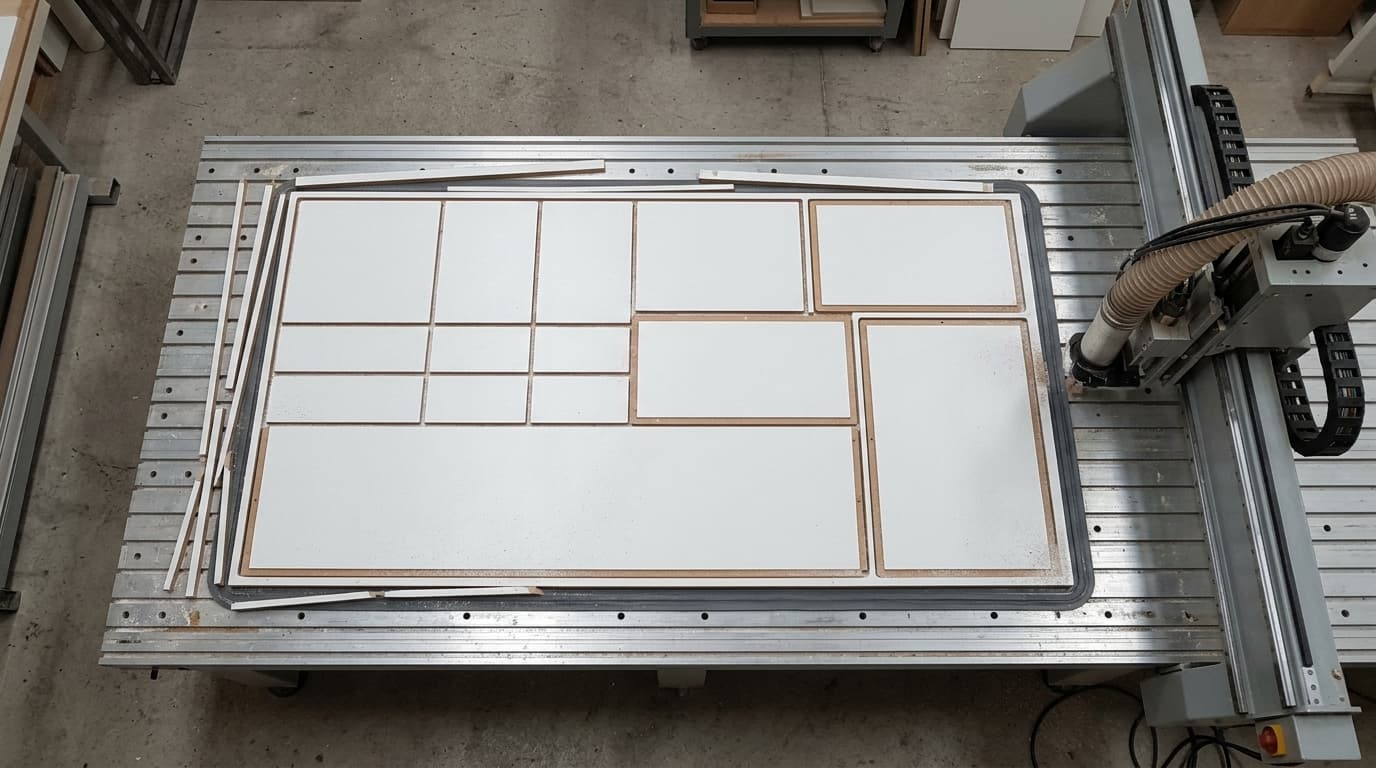
Boards are bought from the supplier as full sheets. Even if the total area of the parts is 4 m², if a 2100 × 2800 mm (5.88 m²) sheet is opened, you pay for the whole sheet. The rest is only recovered if it is kept as an offcut that can be used on another job.
That is why a rough calculation by price per m² can make the board cost look lower than it is. The more accurate way is to take the sheet count from the cutting plan. For waste and layout, see the panel nesting software article, and for sheet sizes, MDF and particleboard sizes.
Cost and quote are not the same thing
Cost is what the job costs you; the quote is the price you give the customer. A quote adds profit, a risk margin for unexpected work, and taxes on top of the cost. Keeping the two separate shows how far you can flex when a discount is requested.
Keeping prices current also matters: when board and hardware prices change, a quote given at the old unit price may leave no profit. Noting the date of the prices a quote was prepared with makes later comparisons easier.
Cost analysis in moducut
In moducut you enter unit prices in the Quote tab opened from Settings › Price List: board, banding (by thickness and decor), hardware and labor per module. The quote uses these prices to produce board, banding, hardware and labor lines; items with no price entered are flagged separately. Prices are saved with the project, so you can later see what prices an old quote was given with.
The Consumables and Cost panel in Nesting Results counts from the actual layout: sheets, edge banding, connectors, hinges, drilling, routing, grooves and notches, plus cutting and banding. You can enter the sheet price per sheet or per m², cutting labor per sheet, part or meter, and add your own items; material and labor totals are shown separately. See the cost analysis page for details, and the linear meter entry for the term.
Frequently asked questions
How is the linear meter price of kitchen cabinets calculated?
Usually the length of the cabinet run along the wall is multiplied by the linear meter unit price. The safest way to find the unit price is to divide the total cost of a few real jobs, calculated item by item, by the total meters of those jobs.
How is a cabinet price calculated?
First the cabinet's cost is worked out: board, edge banding, hardware, labor and a share of overheads. The selling price is found by adding profit and a risk margin on top of this cost; taxes are added separately. Two cabinets of the same width come out at different prices depending on the drawers, hinges and door material they contain.
Is waste included in the board cost?
Yes. You pay for the whole sheets you open, not the net area of the parts; the rest is only recovered if it is used on another job as an offcut.
How is labor added to a cost calculation?
With your own unit prices: per sheet, part or meter for cutting; per module or per day for installation. What matters is using the same method on every job, so jobs can be compared with each other.