Kitchen corner cabinet solutions: L-corner, blind corner and carousel
Updated: Measuring7 min readBy the moducut team
Summarize this article with an AI tool:
Short answer
Why is the corner the hardest part of a kitchen?
In an L- or U-shaped kitchen, two runs of cabinets meet at the corner. At this meeting point the depths of the two cabinets overlap and create a volume that is hard to reach. If it is not designed properly, this volume is either not used at all or the doors lock each other. The corner is also where measuring mistakes show up most: walls are not exactly 90°, the plaster bulges, and services often run through the corner.
L-corner cabinet
A single carcass with two wings. Each leg is commonly 85–100 cm; the most used size is 90 × 90 cm.
Advantages:
- The whole corner volume is gathered in one cabinet.
- A carousel can be fitted inside.
Points to watch:
- The doors are either hinged as two separate doors, or a bi-fold door hinged to each other is used. A bi-fold door needs special hinges.
- Because the carcass is large, it needs care in delivery and installation.
- If there is an L cabinet under the countertop, the sink or hob should not be placed too close to the corner.
Blind corner cabinet
Part of one cabinet sits behind the neighboring cabinet. From the front it looks like a normal cabinet; the back part is “blind”.
Advantages:
- It is the most flexible solution in terms of size. The width of the blind part can be adjusted to the wall length.
- The carcass is simple and the cost is low.
Points to watch:
- The blind section is hard to reach. Pull-out basket mechanisms (half-moon, magic corner) make this space usable.
- If a mechanism will be used, the widths of the blind part and the open part must follow the manufacturer's table.
Corner solutions with mechanisms
| Mechanism | How does it work? | Suitable cabinet |
|---|---|---|
| Carousel | Round or cloverleaf shelves that rotate in the corner | L-corner |
| Half-moon | Half-round shelves swing out when the door opens | Blind corner |
| Magic corner | Rear baskets slide forward, front baskets slide out | Blind corner |
| Corner drawer | Drawers with V-shaped fronts that reach into the corner | Special corner carcass |
Each mechanism has a minimum carcass width, door size and blind part width set by the manufacturer. Before starting the drawing, get the technical table for the mechanism you will use and set the carcass size accordingly. If the mechanism is chosen later, the carcass may have to be cut again.
Fillers and door clashes
At the corner, two doors meet at a right angle. If no filler is left between them:
- The doors hit each other when opening.
- Handles hit the neighboring door or handle.
- Drawers cannot open unless the corner door is open.
That is why a 5–10 cm filler is added next to the corner cabinet. The filler width is set by the handle length, door thickness and the hinge's opening angle. With projecting handles, the filler is kept wider.
If the oven, dishwasher or fridge is near the corner, their doors are taken into account too. If the dishwasher door is too close to the corner, it locks the corner cabinet door when opened; this is one of the most common problems noticed after installation.
Corners in wall cabinets
The same options apply to wall cabinets, but because the depth is less (commonly 30–35 cm), the blind corner loss is smaller. An L-corner or an open corner shelf is usually preferred in the upper corner. If the hood is near the corner, the hood chimney and body should be deducted from the corner size.
How do you measure a corner?
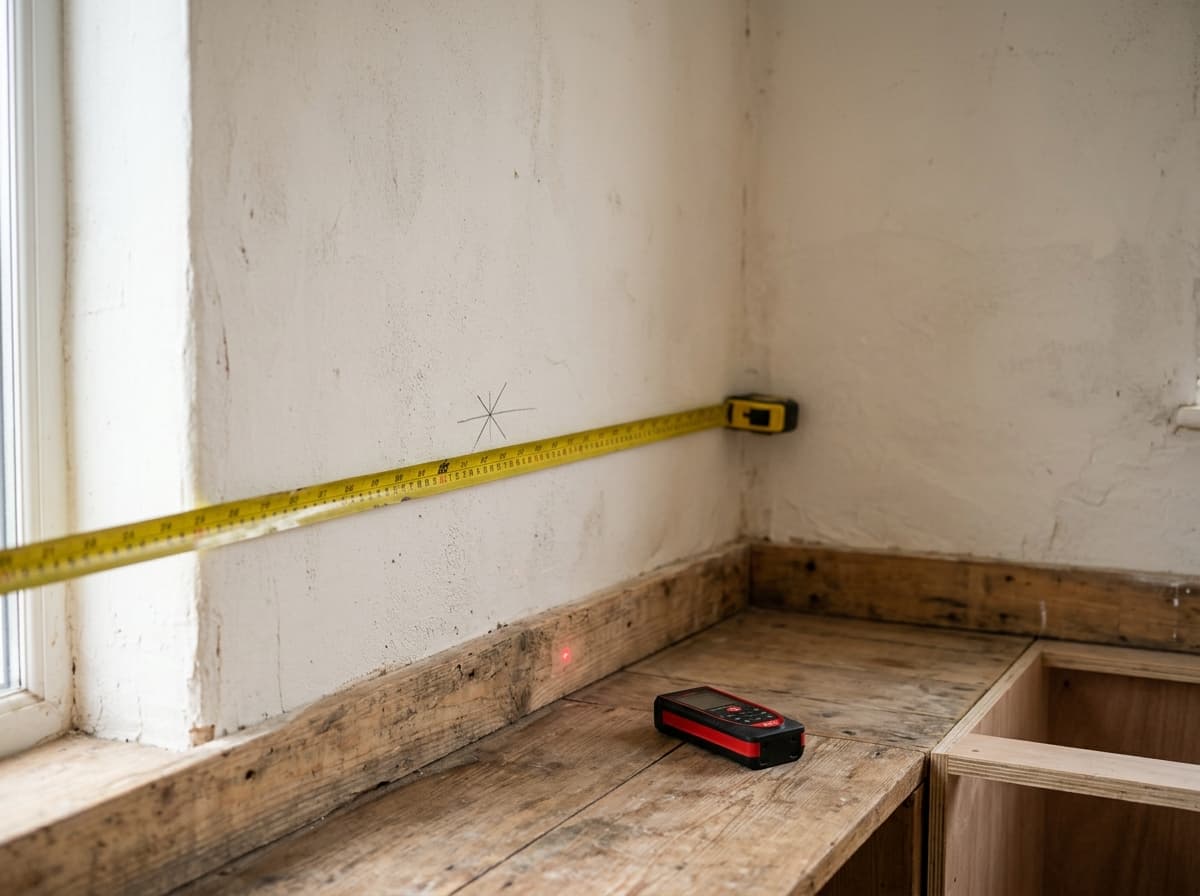
- Measure the two walls separately from the corner. Repeat the measurement at countertop height and at wall cabinet height; the wall may be crooked.
- Check that the corner is square. Mark 60 cm and 80 cm from the corner on each wall; if the distance between the two marks is 100 cm, the corner is 90° (the 3-4-5 rule).
- Plaster bulges and columns. If there is a column or a build-up of plaster in the corner, the cabinet carcass is notched or the filler widened.
- Services. Check whether water, gas and electric lines run through the corner.
- Appliance doors. Mark the opening area of appliances near the corner.
For a measuring guide, see our furniture measurement and part takeoff article, and for standard sizes, kitchen cabinet dimensions.
Which one should you choose?
- Limited budget, flexible corner: Blind corner + simple shelf.
- Corner volume is valuable, both walls long enough: L-corner + carousel.
- Access comes first, budget allows: Blind corner + magic corner or half-moon mechanism.
Corners in the drawing
The corner cabinet is the module where most drawing mistakes happen, because the sizes of the neighboring cabinets, the filler and the door gaps all depend on each other. When the corner module comes predefined, the filler and door sizes are calculated together. In moducut, blind corner and L-corner modules are ready in the library; out-of-square walls and column notches can also be shown in the drawing. Details: Drawing.
Frequently asked questions
How wide should the blind part of a blind corner cabinet be?
If no mechanism will be used, it is free to suit the wall length. If a mechanism will be used, follow the size given by the manufacturer.
Can a sink go in the corner?
It can, but because the corner cabinet is deep, reaching the sink becomes harder and access to the plumbing is limited. In most designs the sink is moved at least one module away from the corner.
Bi-fold door or two separate doors on an L-corner cabinet?
A bi-fold door opens in one movement and gives better access; two separate doors are cheaper, but both have to be opened.