Choosing drawer slides: ball-bearing, undermount and drawer box systems
Updated: Hardware7 min readBy the moducut team
Summarize this article with an AI tool:
Short answer
Why does the slide choice change the cut list?
A drawer slide looks like just a hardware choice, but it sets the size of every part of the drawer. In the same 60 cm carcass, the drawer box is cut to one size with ball-bearing slides and another with undermount slides. If the slide type changes later, all the drawer parts are recalculated. That is why the slide should be chosen at the drawing stage.
Types of drawer slides
Ball-bearing (telescopic) slides
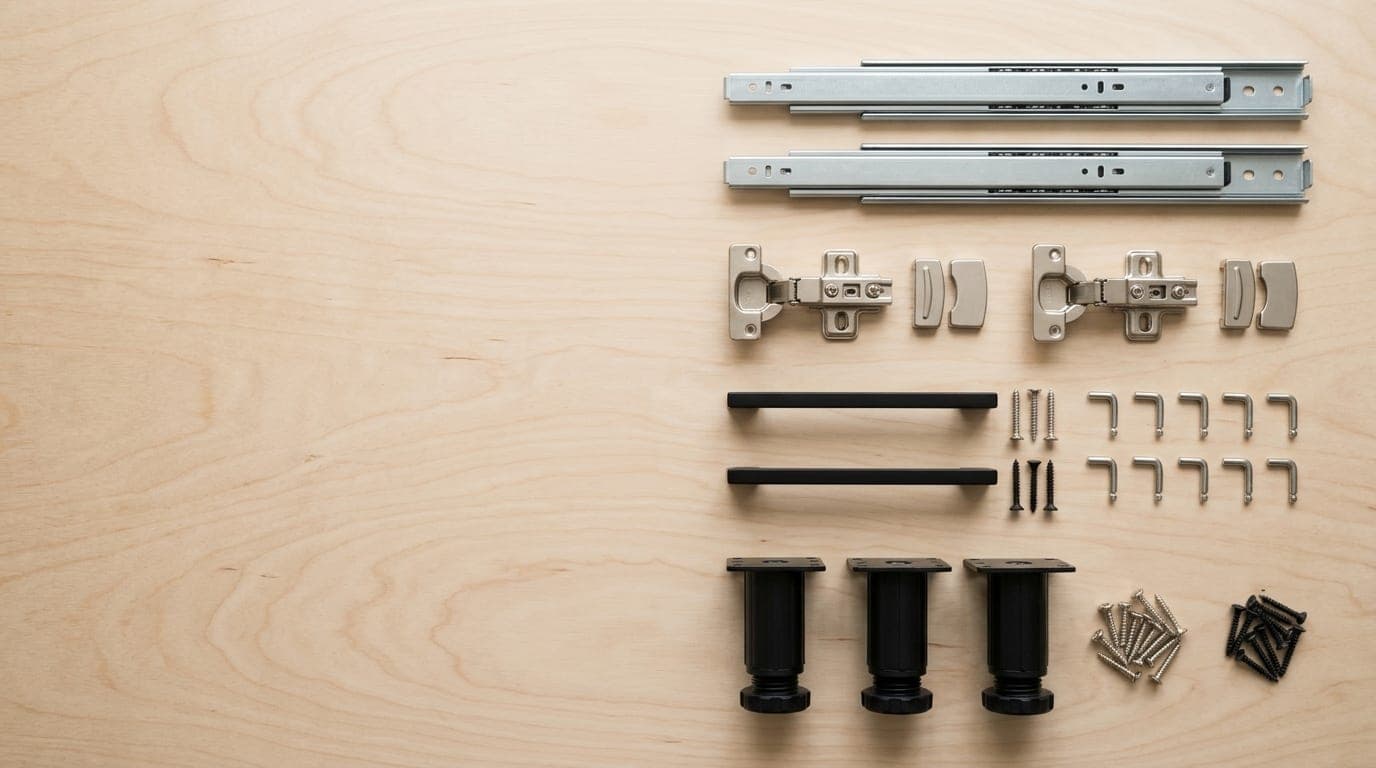
A slide screwed to the side wall, with balls running inside steel profiles.
- Partial extension: About three quarters of the drawer depth comes out. Economical.
- Full extension: The whole drawer comes out, so items at the back are easy to reach.
- Soft-close: Slows down when closing and closes quietly.
- Push-open: Opens when pressed at the front, for handleless designs.
The slide is visible from the side when the drawer is open. It is common in workshop jobs, internal wardrobe drawers and budget kitchens.
Undermount slides
They sit under the drawer bottom and cannot be seen even when the drawer is open. Soft close is standard on most models. The drawer bottom and back are machined for the slide: a notch or hole in the back for the slide, and space under the bottom for the locking device. These operations should be noted on the cut list and in the CNC operations.
Box systems (metal sides)
The drawer sides and slide come together ready-made. The shop cuts only the bottom, back and front panel. Installation is fast and the look is neat. The box size depends entirely on the manufacturer's formula; the formula changes from brand to brand, and even between different series of the same brand.
Comparing slide types
| Ball-bearing | Undermount | Box system | |
|---|---|---|---|
| Visibility | Visible from the side | Hidden | Metal side visible |
| Side clearance | ~12.5–13 mm each side | Manufacturer's table | Manufacturer's table |
| Soft close | Optional | Standard on most | Standard on most |
| Parts cut in the shop | Sides, front, back, bottom | Sides, front, back, bottom (machined) | Front, back, bottom |
| Cost | Low | Medium–high | Medium–high |
How do you choose slide length?
The slide length is chosen as the standard length closest to, but shorter than, the inside depth of the carcass. Slides are usually available in lengths from 25 cm up to 60 cm in 5 cm steps.
Example: In a base cabinet with an inside depth of 55 cm, a 50 cm slide is used. The space left at the back gives both an installation allowance and room for the back panel and services. If the slide is longer than the inside depth, the drawer will not close fully; if it is too short, the back of the drawer is wasted.
How is the drawer box size calculated?
With ball-bearing slides
- Box outside width = carcass inside width − (2 × slide clearance)
- Box depth = slide length (often the same as the slide length or a few mm shorter)
- Box height = shorter than the front panel; the front panel covers the box
Example: In a carcass with an inside width of 564 mm, with 12.5 mm of slide clearance on each side, the box outside width is 539 mm. If the box sides are cut from 16 mm material, the front and back parts are cut at 539 − 32 = 507 mm long.
With undermount slides and box systems
Apply the formula given by the manufacturer. In these formulas, the drawer inside width is usually found by subtracting a fixed number from the carcass inside width; the back height and bottom notch are also given in the table. If the size is wrong, the slide either binds or has play, and the drawer runs crooked.
To avoid doing this calculation by hand for every drawer, you can use the drawer size calculator.
Load capacity
Slides are classed by the load they can carry. Common ranges:
- Light (25–30 kg): Internal wardrobe drawers, cutlery drawers.
- Medium (40–50 kg): General kitchen drawers.
- Heavy (60 kg and up): Pot drawers, pantry drawers, wide bottom drawers.
On drawers wider than 80–90 cm, using a synchronization bar keeps the drawer from running crooked when pulled from one side.
Front panel and overlay
The drawer front panel is the visible part screwed to the front of the box. Its size is calculated by the same rule as doors: full overlay, half overlay or inset on the carcass. A gap of 2–3 mm is commonly left between stacked drawer fronts. For overlay calculation, see our hinge types and door overlay article.
Common mistakes
- Cutting drawer parts before the slide type is decided.
- Forgetting the back notch and bottom machining for undermount slides.
- Fitting a light-duty slide to a heavy drawer.
- Calculating the carcass inside width from the outside size without deducting the panel thickness.
- Not allowing for gaps between front panels.
Drawers from the drawing
Slide clearance, bottom thickness and front panel overlay are recalculated for every drawer. When a drawer is defined in the drawing together with its slide type, the box parts go onto the cut list with their sizes, and the number of slides is added to the hardware list. In moducut, drawer modules come ready-made; you can see how the hardware list is produced on the Hardware list page.
Frequently asked questions
Are soft-close slides a must?
Not a must, but they stop drawers from slamming shut and extend their life. They have increasingly become standard in kitchens.
Can undermount slides be fitted to an old drawer?
Usually not; undermount slides need specific box sizes and bottom machining. For old drawers, replacing ball-bearing slides is more practical.
What should I look for when buying slides?
Length, extension type (partial/full), load capacity, soft close, and the side clearance needed for installation.